 Pristupačnost
.jpg)

KORISNE POVEZNICE
KORISNE POVEZNICE


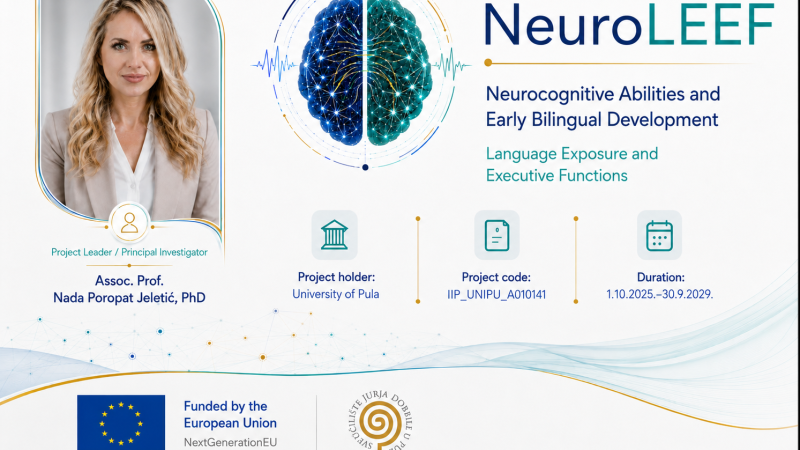
Izv. prof. dr. sc. Nada Poropat Jeletić je od 6. travnja do 31. listopada 2026. godine bila Visiting Research Associate na Sveučilištu u Cambridgeu te je u sklopu međunarodnih diseminacijskih aktivnosti, tijekom boravka predstavila znanstveno-istraživački projekt Neurocognitive Abilities and Early Bilingual Development: Language Exposure and Executive Functions – NeuroLEEF (Funded by the European Union) pri Brain, Language and Bilingualism Lab-u Sveučilišta u Cambridgeu, jednog od najznačajnijih svjetskih istraživačkih centara u području kognitivne neuroznanosti i dvojezičnosti. Istraživanja koja se provode u sklopu laboratorija usmjerena su na razumijevanje kognitivnih i neuralnih mehanizama koji omogućuju razumijevanje i proizvodnju govora te na proučavanje neuroplastičnih prilagodbi povezanih s učenjem i uporabom dvaju ili više jezika. Primjenom bihevioralnih i neuroimaging metoda istražuju se neuralni procesi odgovorni za obradu govornog jezika, s posebnim naglaskom na razumijevanje posljedica višejezičnosti za razvoj i organizaciju kognitivnih sustava. Posebna istraživačka pozornost usmjerena je na ispitivanje neuralnog kodiranja govora kod ranih i kasnih dvojezičnih govornika te na usporedbu mehanizama pažnje i jezične obrade kod dvojezičnih i jednojezičnih ispitanika. Boravak na Sveučilištu u Cambridgeu pružio je iznimnu priliku za razmjenu znanstvenih znanja i stručnih iskustava, uspostavljanje novih međunarodnih istraživačkih partnerstava te daljnje promicanje interdisciplinarne suradnje u područjima dvojezičnosti, usvajanja jezika, kognitivne neuroznanosti i razvojne psihologije. Ujedno predstavlja važan korak prema budućim zajedničkim znanstvenim suradnjama na NeuroLEEF projektu i drugim istraživačkim inicijativama u okviru znanstvenog projekta Sveučilištu u Cambridgeu Mapping the Predictors of L2 Grammar Proficiency in Adolescence.
Associate Professor Nada Poropat Jeletić Presented the NeuroLEEF Project at the University of Cambridge
Associate Professor Nada Poropat Jeletić served as a Visiting Research Associate at the University of Cambridge from the 6th April to 31st October 2026. As part of the project's international dissemination activities, she presented the research project Neurocognitive Abilities and Early Bilingual Development: Language Exposure and Executive Functions (NeuroLEEF)(Funded by the European Union) at the Brain, Language and Bilingualism Lab, University of Cambridge, one of the world's leading research centres in the fields of cognitive neuroscience and bilingualism. Research conducted within the Brain, Language and Bilingualism Lab focuses on understanding the cognitive and neural mechanisms underlying speech comprehension and production, as well as the neuroplastic adaptations associated with learning and using two or more languages. Employing a combination of behavioural and neuroimaging methodologies, researchers investigate the neural processes involved in spoken language processing, with particular emphasis on the effects of multilingualism on the development and organisation of cognitive systems. A major line of research examines the neural encoding of speech in early and late bilinguals, alongside comparative investigations of attentional mechanisms and language processing in bilingual and monolingual populations. The NeuroLEEF project addresses fundamental questions concerning bilingualism, language development, and cognitive neuroscience, with a particular focus on the development of executive functions in children. Specifically, the project investigates inhibitory control, cognitive flexibility, task-switching ability, divergent non-verbal thinking, and working memory, thereby contributing to a deeper understanding of the relationship between early bilingual language exposure and neurocognitive development. The research stay at the University of Cambridge provided an exceptional opportunity for the exchange of scientific knowledge and professional expertise, the establishment of new international research partnerships, and the further advancement of interdisciplinary collaboration in the fields of bilingualism, language acquisition, cognitive neuroscience and developmental psychology. It also represents an important step towards future collaborative research activities within the NeuroLEEF project, as well as other research initiatives undertaken as part of the University of Cambridge project Mapping the Predictors of L2 Grammar Proficiency in Adolescence.


Sveučilište Jurja Dobrile u Puli
A: Zagrebačka 30
52100 Pula
Hrvatska
T: +385 52 377 024
E: ured@unipu.hr
W: www.unipu.hr
Studenti: ured-za-studente@unipu.hr
T: +385 52 877 423, +385 52 877 435
Istaknuti sadržaj


